Stuck Transaction? Price the Wait Against a Day of Mining
A withdrawal that sits unconfirmed for six hours feels like an emergency, and the numbers rarely support the feeling. At 170 TH/s a rig earns 0.00007626 BTC a day, or $6.46 gross and $6.20 net at BTC $84,692. Weighing a stuck transfer against that figure is a better way to decide whether to queue for free acceleration or pay for it than watching a block explorer refresh.

Key takeaways
- Free acceleration needs a transaction of 0.5 KB or smaller and a fee rate of at least 0.0001 BTC/KB; miss either test and only the paid route remains.
- Paid submissions are settled in BTC, BCH or LTC, and the fee leaves your account whether or not the transaction confirms.
- A transaction carrying unconfirmed inputs cannot be accelerated until the earlier transfer confirms.
- At 170 TH/s, one day of mining is worth $6.20 net, which is the natural yardstick for any acceleration decision.
Two clocks, one decision
A stuck transaction runs on a clock measured in blocks. A mining operation runs on a clock measured in hours, because PPS+ credits the block-reward component every hour against current difficulty. When a transfer is late, both clocks start competing for attention, and the temptation is to solve the visible problem with the most expensive tool available. Separating the two makes the choice much calmer.
Ask what the transfer is actually blocking. If it is a payment to a supplier with a deadline, the cost of delay is contractual. If it is a move between two wallets you own, the cost of delay is close to zero and the only question is whether the fee was simply too low. Most stuck transfers in the second category resolve themselves within a few blocks once the queue clears, and paying to hurry them is paying for impatience.
What the free queue accepts
The Transaction Accelerator has two conditions for a free submission, and both must hold. The transaction must be 0.5 KB or smaller, which covers an ordinary payment with a handful of inputs and excludes anything assembled from many small coins. The fee rate must be at least 0.0001 BTC/KB. A transfer that meets both tests joins an hourly quota and is processed first in, first out.
That last detail is worth internalising. Being eligible is not the same as being early. The quota refreshes each hour, and a submission made late in the hour may wait for the next window, which is a different kind of delay from the one you were trying to escape. Submit near the start of a window if the timing matters, and expect the queue to be longer when the mempool itself is busy.
| Size | Fee rate | Free queue | Practical route |
|---|---|---|---|
| 0.25 KB | 0.0002 BTC/KB | Eligible | Submit and wait for the hourly window |
| 0.50 KB | 0.0001 BTC/KB | Eligible at the boundary | Submit early in the hour |
| 0.80 KB | 0.0003 BTC/KB | Not eligible, too large | Paid option only |
| 0.40 KB | 0.00005 BTC/KB | Not eligible, rate too low | Paid option or wait for the mempool to drain |
The boundary row is the one people misread. A transaction of exactly 0.5 KB with a fee rate of exactly 0.0001 BTC/KB passes both tests, but it has no margin. If either value drifts because the wallet rebuilt the transaction, it falls out of the free tier. Wallets that pad transactions or add change outputs can push a payment over the size line without the sender noticing.
What a paid submission buys
The paid route through ViaBTC TX Accelerator takes BTC, BCH or LTC and debits the account directly. What it buys is inclusion in the next block that the pool mines, not a specific block height and not a guarantee about when that block arrives. A pool with a small share of the network finds blocks less often than a large one, so the wait after submission still varies. The difference is that the transaction no longer competes on fee rate with everything else in the mempool.
Two rules make the paid route final in a way that surprises first-time users. The submission cannot be cancelled, and the fee is not refunded if the transaction later confirms through ordinary mining before the pool's next block. You are buying a place in a queue, not an insurance policy. Read that as a reason to submit once and correctly rather than twice in a hurry.
When the wallet refuses to help
Acceleration fails on a transaction that spends outputs which are themselves unconfirmed. This is a chain-of-payments problem: the tool can only push a transaction whose inputs already exist on the chain. The fix is to accelerate the earlier transfer first and wait for it to confirm, then return to the later one. Wallets that let you spend incoming coins immediately create this situation without warning.
Double-spend attempts are also rejected. That is not a policy quirk but a definition: a transaction that conflicts with one already seen cannot be included in a block without invalidating the other. If a wallet has broadcast two versions of the same payment, resolve which one you want before submitting anything, because the accelerator will only ever see one of them.
The mempool is not a queue
A queue serves whoever arrived first. The mempool serves whoever paid enough per kilobyte, and the ordering can change with every block. That is why two transfers broadcast minutes apart can confirm in the opposite order, and why a payment sent at a quiet moment may sit behind one sent later at a higher rate. Arrival time explains very little of what happens next.
Blocks arrive on average every ten minutes, but the average hides long gaps. A transfer that has waited thirty minutes has not been treated unfairly; it has simply not been in a block yet. Judging the situation by elapsed time rather than by fee rate relative to the current queue is the fastest way to make a calm decision into an expensive one.
What to write down when a transfer stalls
Five items cover almost every case: the transaction identifier, the time it was broadcast, its size in kilobytes, its fee rate, and what the recipient requires before releasing the goods. With those five, any support conversation or acceleration decision becomes a matter of arithmetic rather than recollection.
Add one more line for the outcome, and the note becomes a record. After three stalled transfers, the pattern usually names the cause: a wallet defaulting to a low rate, a habit of spending many small outputs, or an exchange that demands more confirmations than the shop assumed. None of those is visible from a balance alone.
Worked example
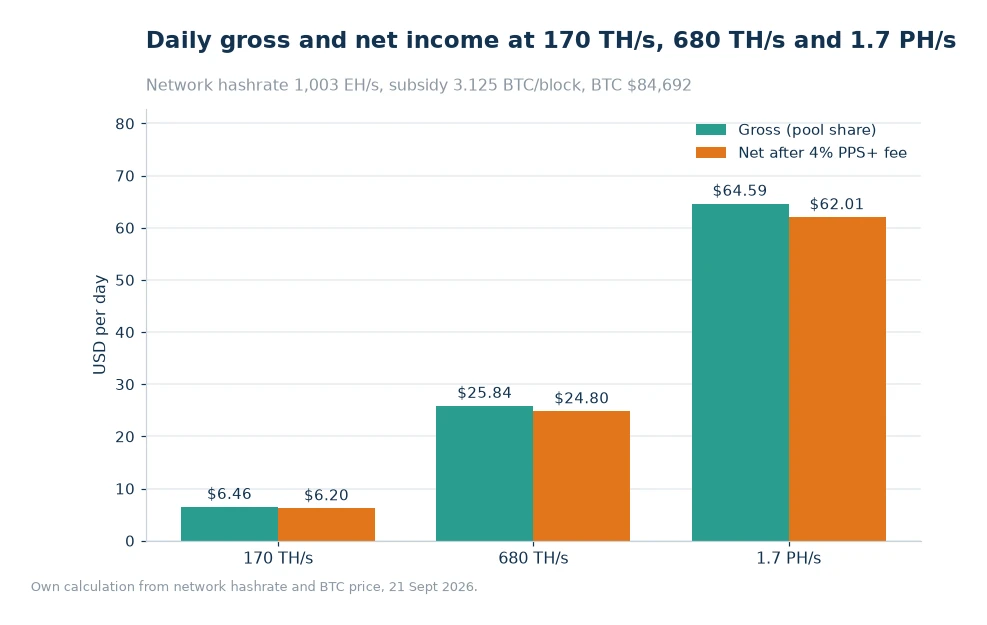
Put a value on patience with the figures from the chart, which uses three hashrates that scale by simple multiples.
- The network issues 450 BTC a day over 1,003,000,000 TH/s, so a terahash is worth 0.0000004486 BTC daily.
- At 170 TH/s: 170 × 0.0000004486 = 0.00007626 BTC a day, and 0.00007626 × 84,692 = $6.46.
- After the listed 4% on the block-reward component: 6.46 × 0.96 = $6.20.
- 680 TH/s, four rigs of 170: 4 × 0.00007626 = 0.00030505 BTC, $25.84 gross and $24.80 net.
- 1.7 PH/s is ten rigs: 10 × 0.00007626 = 0.00076263 BTC, $64.59 gross and $62.01 net, or $2.58 an hour.
- A one-day delay therefore costs a 1.7 PH/s operation $62.01 in credit. If the stuck transfer is worth $40, waiting is cheaper than paying to hurry it.
Frequently asked questions
What makes a transaction eligible for free acceleration?
A size of 0.5 KB or less together with a fee rate of at least 0.0001 BTC/KB, submitted into an hourly quota that is served first in, first out.
Can I cancel a paid acceleration request?
No. A submission cannot be cancelled and the fee is not refunded, including when the transaction confirms through ordinary mining before the next block the pool produces.
Why is my transaction rejected for unconfirmed inputs?
The tool can only push a transfer whose inputs already exist on chain, so a payment built from coins that have not confirmed must wait until the earlier transfer settles.
Build the habit before the next stuck transfer
Keep the fee rate of your routine transfers at or above 0.0001 BTC/KB and their size below 0.5 KB, and the free route stays open when you need it. That usually means consolidating small outputs during quiet periods rather than on the day a payment has to move. Check the size before broadcasting, because a wallet that adds inputs at the last moment can double it.
When something does stall, open the accelerator page and test the two conditions before touching the paid option. The multi-currency wallet shows the transfer alongside your mining balance, so you can see what a day of delay is worth in the same window. The pool statistics page tells you how often blocks are being found, which is the missing input in most guesses about waiting time.
Sources: the ViaBTC accelerator guide and fee schedule[1]. Read on 21 Sept 2026: 1,003 EH/s of network hashing power, 132.76 T difficulty, 3.125 BTC each block, 144 blocks per day, BTC $84,692. Published 24 Oct 2026; confirmation depends on when the pool finds its next block.