Home Charging vs Public Fast Chargers in Australia
Home charging covers the ordinary week; public fast charging covers the exception. The published numbers make that split easy to understand: XPENG vehicles accept most public Type 2 AC and CCS2 DC chargers, and a 10-80% state-of-charge top-up takes 12 minutes. If you own an elctric suv that spends most nights in a driveway, the second number matters far less often than the first.
Key takeaways
- Type 2 AC covers home and workplace charging; CCS2 DC covers public fast charging.
- A 10-80% charge is published at 12 minutes, on a platform the New G6 shares across variants.
- Home features include plug-and-charge, a charging schedule and an anti-theft locking function.
- The charge flap sits on the right rear quarter panel: press the top-left corner, then connect.
Home charging: the routine that removes planning
Home charging is slow, cheap and invisible. A wallbox feeds AC power through the Type 2 connector into the car's onboard charger, which is why a full session runs for hours rather than minutes, and why the car is normally full before you need it. The published features are built for exactly that pattern: plug-and-charge so a session starts without a card or an app, a charging schedule so the car draws power inside an off-peak window, multi-account sharing for a household with more than one driver, and an anti-theft locking function so the cable cannot simply be unplugged and walked away with. None of it is exciting, and all of it is the reason owners stop thinking about charging within a month.
Public fast charging: when 12 minutes is the whole point
Public DC charging exists for the days that break the routine. On the New G6, the published 10-80% window is 12 minutes on the 800-volt platform, with 5C battery technology, and the site headlines the battery as Australia's first of its type. A separate published figure of up to 427 km of charge added in 15 minutes carries the site's own footnote: it comes from internal tests of the G6 RWD Long Range. That kind of speed changes how a long drive feels, because two or three short stops replace one long one, and the stop you take is decided by where the coffee is rather than by where the plug is.
The physical bits worth knowing once
The charge flap is on the right rear quarter panel, and the published procedure is to press the top-left of the flap before connecting the cable. That single detail tells you to reverse into charging bays, which is the habit nearly every owner develops early. Cable handling is the other small skill: a DC lead is heavier and less flexible than an AC lead, so the first sessions are slower while you work out how to loop it back onto the holster without dragging it across the paint. On compatibility, XPENG vehicles work with most public Type 2 AC and CCS2 DC chargers, and some Tesla Supercharger sites in Australia are open to non-Tesla CCS2 vehicles, with the site advising a check of the Tesla app because not all sites support cars from other brands.
| Question | Home AC | Public DC |
|---|---|---|
| Connector | Type 2 | CCS2 |
| Typical use | Overnight and workplace top-ups | Highway and long-distance stops |
| Session length | Hours | Published 10-80% in 12 minutes |
| Published features | Plug-and-charge, schedule, locking, multi-account | Compatible with most public CCS2 chargers |
When a wallbox is not an option
Plenty of Australian households park on the street, in a shared basement without a dedicated circuit, or in a rental where drilling a wall is not permitted. None of that rules out an electric car, but it does change the plan. The fallback is public AC charging, which is slow and cheap relative to DC, and is best used where the car already sits for hours: a workplace car park, a station commuter lot, or a shopping centre on a long errand. Public DC then covers the rest, and the published 10-80% window of 12 minutes means a weekly top-up is a short stop rather than an evening commitment. The planning discipline is to identify two or three reliable chargers on your regular routes rather than hunting for the nearest one in an emergency, and to keep the car above a comfortable margin in winter. It is more effort than plugging in at home, and it is a genuine option rather than a compromise that only works on paper.
What each one costs you, in illustrative terms
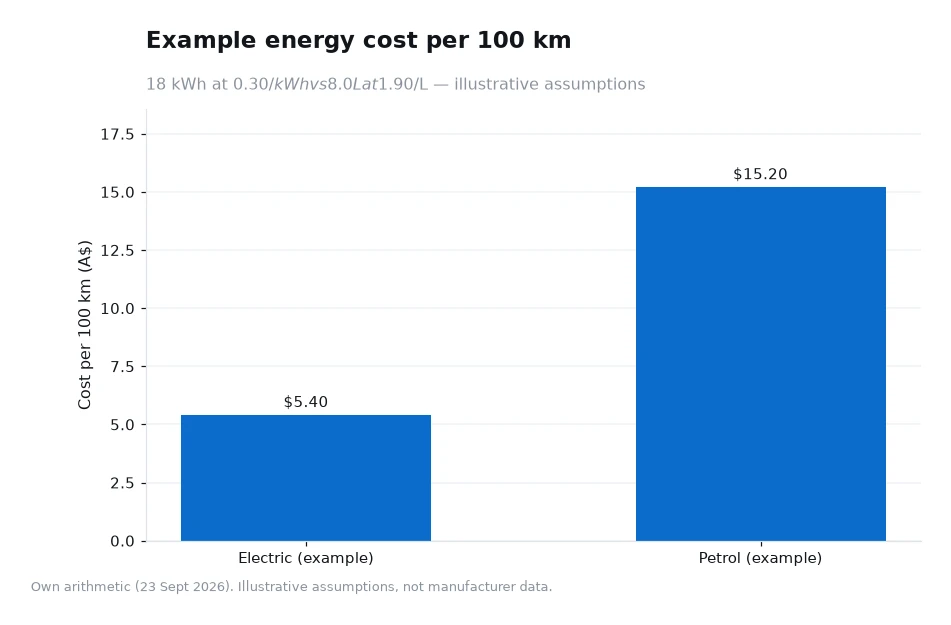
Rates vary by retailer, by time of day and by charger operator, so the honest way to compare is to state the assumptions and then change them. Take 18 kWh per 100 km of consumption, $0.30 per kWh on a home tariff, and a petrol comparison of 8.0 L per 100 km at $1.90 per litre. Home energy: 18 x 0.30 = $5.40 per 100 km. Petrol: 8.0 x 1.90 = $15.20 per 100 km. The gap is 15.20 - 5.40 = $9.80 per 100 km. Public DC is usually priced higher per kWh than a home tariff, which is why the arithmetic above uses the home rate for the electric figure rather than pretending the two are the same. The figures are my own assumptions, not manufacturer data, and the chart below shows exactly these two bars.
Worked example: a year of home charging against a year of petrol
Continuing the same illustrative assumptions, plus an annual distance of 15,000 km. That is 15,000 / 100 = 150 blocks of 100 km. Electric: 150 x 5.40 = $810 a year, which is 810 / 12 = $67.50 a month. Petrol: 150 x 15.20 = $2,280 a year, or 2,280 / 12 = $190 a month. The difference is 2,280 - 810 = $1,470 across the year. Now assume a quarter of those kilometres are covered by public DC charging at an assumed $0.60 per kWh instead of $0.30: the affected distance is 15,000 x 0.25 = 3,750 km, or 37.5 blocks of 100 km, using 37.5 x 18 = 675 kWh, which at the higher rate is 675 x 0.60 = $405 rather than 675 x 0.30 = $202.50. The year's total rises by 405 - 202.50 = $202.50, taking the electric figure to about $1,012.50. Still well under the petrol number, and that is with a deliberately pessimistic mix.
Frequently asked questions
Do you need a home charger to own an electric car in Australia?
No, but it changes the ownership experience. Public Type 2 AC and CCS2 DC chargers are available and the vehicles are compatible with most of them. Home charging is simply cheaper per kilometre and removes planning from the average week, which is why most owners start there.
How long does a public fast charge take?
The published figure for a 10-80% state-of-charge top-up is 12 minutes on the New G6, using its 800-volt platform and 5C battery technology. The site also publishes up to 427 km of charge added in 15 minutes, a figure its own footnote attributes to internal tests of the G6 RWD Long Range.
Where to start
Work out your weekly distance first, because that decides whether home charging is a convenience or a necessity. Then check what your meter offers, set a schedule inside the least expensive window you have, and treat public charging as the tool for long trips rather than the default. The charging page holds the connector and home-hardware detail, and the Australian range overview is the quickest way to see which models publish those figures.
Connector compatibility, charge times and home-charging features quoted here come from the manufacturer's Australian website as read on 23 Sept 2026, including the internal-test footnote attached to the 427 km figure. All cost figures are my own illustrative assumptions, not manufacturer data, and electricity and fuel prices vary by location and retailer. [1]