First Week With an Adult AI Chat Subscription
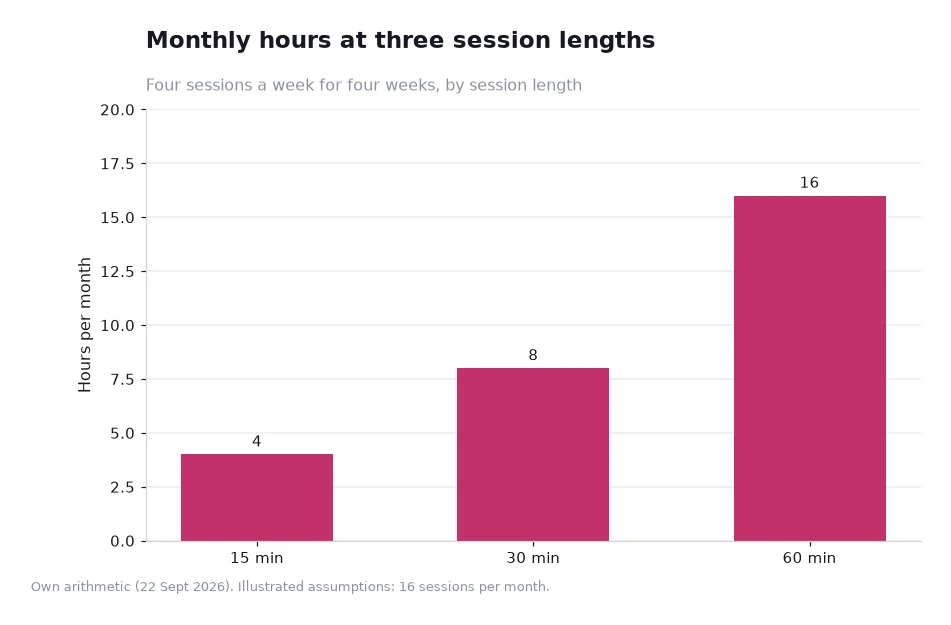
The first week of a paid plan should be run as a test, not a celebration. Seven days is enough to measure whether the things you are paying for actually change your use: four sessions in the week at half an hour each is two hours, and the same rhythm across a month is 16 sessions, or 8.0 hours. Write those numbers down on day one and check them on day seven.

Key takeaways
- Day one is a baseline: count sessions, minutes and messages before you change anything else about your habit.
- Test one thing per day — continuity, discovery, a long session, a resumption after a gap — rather than judging everything at once.
- Illustrative scale: 40 messages a day is 280 in a week and 1,200 in a 30-day month.
- Crushon describes Sex AI companions as adapting to your personality and remembering your preferences, which gives the week three concrete things to verify.
Day one: measure the baseline
Before deciding whether the plan is worth keeping, record what you actually do. Count the sessions in one day, the minutes each lasted and roughly how many messages you sent. Most readers overestimate their usage, and a baseline prevents the second week from being judged against an imaginary first one.
Two figures are enough to start: minutes of use and characters saved. If day one produces a 30-minute session and no save, write that down. It is not a bad result; it is the zero point, and every later day will be compared with it.
Also note which access level you are on and which pages you visited. A first-day route through the front page, the character search page and one chat is typical, and knowing the route makes the rest of the week easier to repeat consistently.
Days two to six: one test per day
Spreading the tests avoids the trap of judging a whole service from a single session. Each day answers a different question, and the answers accumulate into a week that is genuinely informative rather than merely pleasant.
Continuity comes first because everything else depends on it. Return to the same character and check whether it resumes with the context you left. Discovery comes second: spend the session finding one new character and keeping it. The long session comes third, and exists to test whether an hour feels different from half an hour or simply longer.
Days five and six test endurance. Resumption after a gap of two days shows what a real break costs. A library review on day six shows what the week produced in saved entries, and it is the day most readers skip — which is why their week has no conclusion.
One rule keeps the week honest: test the level you have paid for and nothing else. Readers who spend the week also comparing other services end up with opinions about four things and measurements of none. If a comparison is genuinely interesting, run the same seven-day table against the second option afterwards and put the two sets of figures side by side, where the difference will be visible without argument.
| Day | Task | Figure to record |
|---|---|---|
| One | Baseline: one session, no changes to your usual habits | Minutes used and messages sent |
| Two | Continuity: return to the same character after a day | Whether the scene resumed on one line |
| Three | Discovery: find one new character and keep it | New saved entries, target one |
| Four | Long session: run a full hour in one sitting | Minutes, and whether it ended on a completed beat |
| Five | Resumption: return after a two-day gap | Minutes needed to restart the scene |
| Six | Review: read the whole saved list | Total saved entries this week |
| Seven | Decision: compare the week with your baseline | Hours used against hours expected |
Worked example: adding the week up
Take an illustrative week of four sessions, each 30 minutes. Four times 30 is 120 minutes, so two hours of use in seven days. If that rhythm continues, a four-week month is 16 sessions and 480 minutes, which is 8.0 hours; at 15 minutes a session the month falls to 4.0 hours and at 60 minutes it rises to 16.0 hours.
Messages scale differently. At 40 a day the week contains 280 messages and the month 1,200. Halve the daily rate and the month halves to 600; double it and the month doubles to 2,400. That is the arithmetic the plan's stated capacity has to cover, and it is why the baseline on day one matters more than any feature list.
The library is the third column. Suppose the week produces two saves, and the pace then doubles each month: month one ends at 2, month two at 4, month three at 8, month four at 16, month five at 32 and month six at 64 — a total of 126 kept characters, which is the sum of 2, 4, 8, 16, 32 and 64. That is an illustrated growth pattern, not a platform measurement, and doubling for six months is deliberately optimistic to show how quickly a library can become unmanageable.
Day seven: the decision
Compare the week with the baseline in three lines: hours used, messages sent, characters kept. If the paid plan changed none of them, the honest conclusion is that the plan is not what was limiting you. If it changed one, decide whether that one is worth renewing for.
Before deciding, read the terms you are actually renewing against. The plan page states what the level includes, and the service's own FAQ notes that some limitations apply under its content and community guidelines whatever level you are on. Knowing that on day seven is better than discovering it in month three.
It is also worth reading what the sex ai service description claims about adaptation and memory recall, since those two claims are exactly what days two and five were designed to test. Your own week is the better evidence, but the comparison tells you whether the gap is your habit or the product.
Frequently asked questions
How much should the first week change my usage?
Less than most readers expect. A week is long enough to notice a difference in continuity and saved entries, and too short to restructure a habit.
Do I need to log everything?
No. Minutes, messages and saves are enough. Anything more detailed turns the week into admin and usually stops the logging altogether.
What if the week is inconclusive?
Run a second week with only the criterion that stayed unclear, then decide. Two weeks of one question beats four weeks of vague impressions.
Run the week once, properly
Set the seven days aside, do the tests in order, and write the three figures down each evening. Then decide on day seven and stop reviewing the decision weekly, because second-guessing a subscription is a habit that costs more attention than the subscription itself.
If you do renew, keep the table for the next month. Comparing month two with week one is the cheapest way to notice that your use has changed shape, and the numbers you already have are the reason you will notice at all.
Data and sources: service description, FAQ wording on restrictions and the adaptive memory behaviour of the platform's companions[1], read on 22 Sept 2026, plus plan wording on the plan page and the trending card counters on the board of 20 entries. Week, month and library figures are worked examples rather than platform measurements. Content is intended for users aged 18 and above; read 22 Sept 2026.